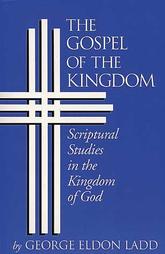
 […] There is a great book that was listed in “Christianity Today,” as one of the top 50 best evangelical books of the modern era. It is George E. Ladd’s, “The Gospel of the Kingdom: Popular Expositions on the Kingdom of God.” He also wrote another book that is currently out of print called, “Crucial Questions Concerning the Kingdom of God,” also, “The Presence of the Future.” He is ‘hands down’ my favorite on the subject. But you asked what the term means “to me”, and what it evokes in me, so I’ll say a little for myself on the subject. […]
Essential “Texts” concerning the Last Days
[…] I would begin with the Lord’s Olivet prophecy in Mt 24, particularly Mt 24:15. In my view, it is the single most important text on which to build a sound understanding of the order and nature of the last day’s events.
In only one place is the question is expressly asked, “What will be the sign of your coming and the end of the age?” Jesus’ answer is clear and forthright, but He presents His answer as incomplete until we have followed His personal instruction to go to Daniel for further understanding (“whoever reads, let him understand”).
There is a simple but profound strategy at work here, and it all begins with our care to honor the Lord’s command to read and understand Daniel, particularly Daniel’s reference to this most pivotal sign.
The Lord knew that when we go to Daniel to find and learn of this event, a much larger and more detailed context begins to unfold. Daniel provides the chronological framework into which all other prophecies of the end find their proper place and order. Not only are we enabled to identify more definitely the time and nature of the desolating sacrilege that begins the great tribulation, but by tracing the events that lead up to and follow from the abomination, we get a much fuller picture of the nature, the time, and purpose of Jacob’s trouble […]
The Tents of Judah
[…] I’ve often marked the Lord’s specificity in His mention of Judea. Why not all of Israel? One would think that a modern invasion force would threaten all of the Land with equal devastation. Well, apparently not at first. And isn’t it particularly interesting that Jerusalem and the nearby West Bank are the two areas in hottest international contention. Jerusalem being the coveted capital of the new Palestinian state. The impression I get is that the Antichrist who has become a figurehead of Islam (as I believe) or who is a political champion of the Muslim world’s claims on the Land (as believed by others), will lead a multinational force in a sudden invasion that will catch Israel off guard and will overwhelm the nation militarily. This happens in the middle of the week (3.5 years after a delusive peace “league”). That is when we will see the abomination of desolation that begins the 42 months of siege (great tribulation). From this point, the Antichrist is physically present in Jerusalem (Dan 11:45). What will this mean for the Jewish inhabitants of the Land? It is clear what it will mean for those living in Jerusalem and the neighboring region of Judea (modern West Bank). That is where many of the settlers reside who take a covenant view of the Land. […]
The pride of your power
[…] God is making a point that will reverberate in the Jewish soul for a thousand years. I want to show in what follows that it is very significant to God’s purpose that the Jerusalem that falls under the power of the Antichrist (Rev 11:2; 13:5) has first come under the control of the orthodox, if not entirely, at least to an unprecedented extent. (Compare Ps 83:12; Isa 28:14-15; 63:18; 64:10-11; Dan 8:13; 9:26-27; 11:22, 31, 36-37; 12:11; Mt 24:15, 20; 2Thes 2:4. ).
The picture one gets from these passages is of a Jerusalem that has accommodated the desire of certain orthodox sects of Judaism to rebuild the temple and restore the ancient ritual of animal sacrifice. This suggests sweeping changes in the current policies of the secular government, since under present circumstances; such a scenario is clearly out of the question. Something’s got to give! […]
When He sees that their power is gone. (A “witnessing” question)
[…] The goal of Jacob’s trouble is to bring the Jew to an end of His own power. It is significant that this is precisely the place where Jesus is revealed to the Jewish heart, namely, at the end of power (“when He sees that their power is gone …” compare Deut 32:36 with Dan 12:7). This is because the strength of the veil that is over the Jewish heart, and indeed over every natural heart, stands in what scripture calls, “the pride of your power” (Lev 26:19). It is what Paul calls, “confidence in the flesh” (2Cor 1:9; Phil 3:3-4). When this is taken away, so is the veil in the revelation of the face of Jesus Christ (2Cor 3:18; 4:6).
I believe the suffering of the Jews during the time of Jacob’s trouble will be different from all other times of covenant curse and judgment, because this time, their suffering will be in the full light of a powerfully declared and fully vindicated display of prophetic fulfillment. (Prophecy as mercy! Rev 19:10).
The presence of a prophetic people that have the key of interpretation (Dan 11:33) and who, because of the liberating power of the gospel, love not their lives unto the death (Rev 12:11), will be the difference between Jacob’s trouble and the Holocaust. One ends with the ultimately humanistic declaration, “never again!” While the other ends by the acceptance of Israel’s history of tribulation as all together just and not unequal to the nation’s corporate guilt (Lev 26:41-43; Hos 5:15; Zech 12:10). Such a corporate acknowledgment will indeed be a miracle of revelation and grace.
So we are to bring into Israel’s consciousness something much more than the case for the supernatural fulfillment of prophecy. We are to study how to press upon Jewish consideration the ancient covenant contention that has burned throughout the long age of exile and that must continue to burn to the end of Jacob’s trouble, when the face of God will be no longer hidden from a then fully regenerate (Isa 54:13; 59:21; 60:21; 66:8; Jer 31:34; Ezek 39:21, 29) and restored nation. […]
“When saw we Thee?”
[…] When it comes to Israel’s unbelief, it is amazing to see all that conspires to reinforce it. Not only centuries of “Christian” antisemitic behavior, but even how certain verses are translated, let alone interpreted, compounds the distance between church and synagogue. Take for example the Jewish translation of Zech 12:10. Compare it with most Christian translations and you will see what I mean. Of course, Christian linguists, such as Walter Kaiser in his book, “the Messiah in the Old Testament” argues the translation question with decisive evidence for the messianic interpretation. But the average believer must take considerable pains to be informed. It may be effective on some occasions, but it’s not always quite as easy as quoting Zech 12:10 as proof that the Jewish nation pierced their own Messiah. .
Or take Dan 9:25-26. Our translations stress our Christian conviction that the anointed one that is “cut off” is the Messiah by capitalizing the word for anointed and translating the passage with a definite article, “the Messiah the Prince”. This is all legitimate, but the informed Jewish position sees this as speaking only of “an anointed prince,” which they typically interpret as referring to Onias III, the officiating high priest who was murdered when Antiochus Epiphanes desecrated the Jewish alter in the 2nd century B.C, who, of course, became the great archetype of the Antichrist in later apocalyptic literature. [..]
Kept From The Hour
But as I have said before: Even if it is insisted that “kept from the hour” should be interpreted as physical exemption, the word “hour” in Revelation is never used of the entire tribulation, but most particularly of the day of God almighty at its end (compare Rev 16:14-16 w/ […]
Role of the Mystery as an Instrument of Judgement
You know, Phil. It’s not that there’s not a beauty and glorious saving power in Christ apart from the context that the mystery provides. The gospel is still a revelation to the heart, even if it is not fully appreciated that it existed in the Old Testament in the form […]
Recommended Reading: Joseph and Jesus
 […] First, let me recommend the below Bible study by long friend, Dean Van Druff: http://www.acts17-11.com/joseph.html I read it today for the second time and was as moved as I was the first time.
Also, I’ve not had much time with it yet, but I’m quite impressed with a book that I found while searching for this topic on Amazon.com It looks to be a very valuable resource for our interest. Other than Dean, this is the only author that I know of who has published something that compares Joseph’s self revelation to his brethren as a type of Jesus’ revelation to Israel at His return. She also says it is something that was for her a new discovery that she considers timely in the church’s relation to Israel. Just today, I notice she expects another expulsion and flight of Jews. That’s a comparatively rare perspective. The book is: “Joseph, Jesus, and the Jewish People: A Gospel Tract Hidden in the Torah” Reggie
Recommended Reading: The First Resurrection by S.P. Tregelles
Reggie, good morning… See attached. I stumbled on to this piece: The First Resurrection by Tregelles. I’m almost certain that you know of it but I was thinking that it may be a good article to post on the new website. Bro. Phil Thanks, Phil. Excellent suggestion. I’ve always wished […]